

HapSports
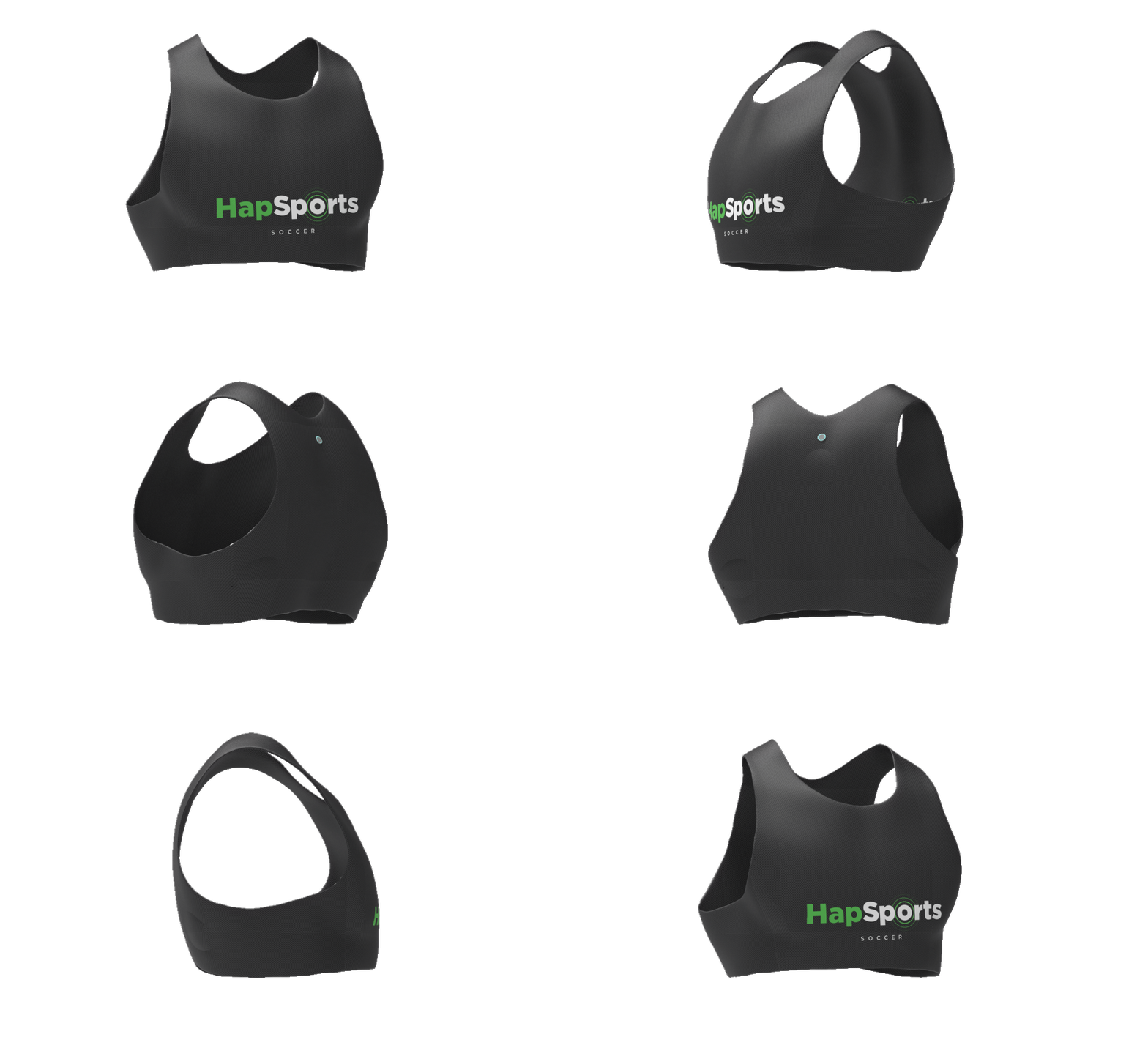
Hapsports is a wearable device that helps deaf people (or hearing impaired) better communicate with players, coaches and referees during a match. It transmits signals through the vibration on the back
Background
The 24th summer edition of the Deaflympics is expected to receive 4,500 deaf athletes and teams from over 100 countries. Deaf sport promotes social and communicative enrichment among individuals who function in a hearing society that imposes social isolation, low self-image, and a sense of being ostracized for being ‘different’.
Information
Roles
Research Leader
Prototype Leader
3D modeling and rendering
UI design
Tools
Course
Figma
Rhino
Keyshot
Adobe suite
Interactive design
UX design
Product design
Timeframe
March 2022
10 Weeks
Problem
-
Deaf athletes are more difficult to get the information of the players on the field, so their teammates have less trust in them.
-
It is difficult for coaches to get the attention of deaf players, as well as hearing players sometimes.
-
Deaf athletes should always pay attention to the visual information outside the court to avoid missing the referee's message
Design Goal
-
HMW Empower soccer players who are deaf and hard of hearing on the field and improve their communication with their coaches and referees?
CONCEPT VIDEO

Timeline

Quick Overview

DESIGN PROCESS
Research Process
1. Secondary Research
We focused on deaf children's soccer and conducted a desktop research on "Basic soccer rules", "Life about Soccer", "Soccer Training ", "Deaf sport", and "Technology".
In each section, we went from "research question" to "research results", and from "insight" to "problems" to investigate and think about the current situation of deaf children in soccer.


We talked and decided that our target group would be deaf high school students who like to play soccer and are around 15-18 years old. And based on the results of our research, we have identified the following directions:
-
The experience of soccer games
-
Parents of deaf children in soccer practice
-
Self-practice of deaf children in soccer
-
Diverse ways of soccer training
-
Coaching of deaf children in soccer
-
Communication between deaf children and teammates
-
Deaf soccer community system improvement
-
Community help for deaf kids' soccer training
2. Stakeholder Map
According to our research, we created a preliminary stakeholder map to show our research results, and discover and determine more details.

3. Interview
We finally settled on the topic of "the experience during a soccer game" and created interview questions to address this topic.

Mallory Clark Guzeev
High School Social Studies Teacher, Coach Phone #: (678) 404-2996
Classroom phone #: 404-300-5857
Atlanta Area School for the Deaf 890 N. Indian Creek Drive Clarkston, GA 30021
Main Office Phone Number [404-296-7101 (voice)/404-348-8401 (VP)] www.aasdweb.com
Deaf players:
Main Questions:
"When did you start playing soccer? How long have you been with your current team?"
"What do you hope to get out of soccer? What is your motivation?"
"What aspect of soccer training do you hope to improve?"
"Can you describe the process of your soccer game, from preparation for the game to the end of the game?"
"Are there any new or emerging technologies in soccer, sports, or in general that you are curious about?"
Interview Insights:
They usually go to play soccer for exercise, to expand their hobbies, and to make more friends
Sometimes in soccer, they do not receive signals from their classmates behind them, resulting in fumbling the ball
Need to spend more energy on visual signals and sometimes miss some key information from the coach or referee
They want to be treated like normal people and do not want to hold the team back
More positive attitude towards high technology
Teammates:
Main Questions:
"When did you start playing soccer? How long have you been with your current team?"
"How do you think playing soccer with deaf players?"
"Can you describe how you interact with deaf athletes during games?"
"What aspect of playing soccer with deaf athletes do you think could be improved?"
"Are there any new or emerging techniques in soccer, sports, or in general that you are curious about?"
Interview Insights:
Would love to have a deaf teammets, but don't know much about sign language and only know some very basic sign language
Deaf athletes have a hard time paying attention to the person behind him while playing, so they have to run to give signals in his line of sight and sometimes miss some scoring opportunities
Sometimes they are slow to respond to in-game signals and need to be cued, such as a coach's rally instructions or a referee's penalty call
Don't mind using tech to improve interaction with deaf players.
Coaches:
Main Questions:
"What age groups or divisions of players do you coach in soccer?"
"What technology or electronic devices are used during training?"
"How familiar are you with training athletes who are deaf or hard of hearing?"
"What behavioral changes have you observed in DHH athletes?"
"Are there any new or emerging technologies in soccer, sports or in general that you are curious about?"
Interview Insights:
The lower the division, the less organized and formal the training becomes
Communication is based on visual cues; coaches have to run up and down the field to remain in their players' peripheral vision
There are very few teams in certain state organizations so DHH athletes tend to play against abled athletes
There is not a lot of digital technology utilised in training either DHH or abled athletes, partially due to the lack of funding or interest
DHH athletes struggle with parental engagement and low morale.
4. Persona
Based on the results of our interviews, we created three personas of deaf players, normal players, and coach.

5. User Journey map
After we decided our HMW question, we created a user journey map to show the current status and issues during the competition, and to identify the opportunities.

Pain Points
1.Deaf players and normal players can't convey signal well during the game.
2. Deaf players only rely on the visual signal, making them tired, and sometimes, they lose some important information during the game.
3. It is easy to ignore the referee's instructions
4. Deaf players can't always receive the coach's instructions in time during the game; sometimes, normal players either.
5. The communication between deaf players and normal people (coach, teammates, and referee) is also bad outside of the soccer game (eg: half time & after game).
Opportunities
1. Improve the efficiency of communication between deaf players and normal players during the game
2. Create more ways for deaf players to receive information during a game
3. Create a new way for referees to send signal to deaf players during a game
4. Create a new way for coach to send the instruction to players during a game
5. Improve the communication experience between deaf players and normal people.
6. How might we?
We collected and organized the all information we have collected, classified it well with affinity diagrams, and gave some HMW questions.


After discussion we have determined that our HMW question is:
"HMW Empower soccer players who are deaf and hard of hearing on the field and improve their communication with their coaches and referees?"
Ideation
1. Brainstorming
Each of the five of us gave eight ideations, and together we presented them and discussed them, using voting to finally decide on our options, with additions and modifications.
2. Initial Concept
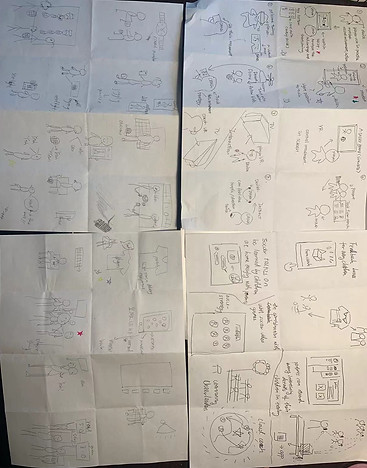
A product that is carried on the arm of a deaf athlete, when the coach wants to give instructional signals, click on the app and the product will vibrate according to different instructions.
User Interface Sketches


Storyboard
Current Situation

Concept 1 solution

3. Assumptions
1. The coach's process is complicated when giving signals and maybe misses goal scoring opportunities
--> How can the coach give timely feedback/how can the process of giving signals by the coach be simplified?
2. There are many different instructions on the court depending on the situation
-->How do you distinguish between different instructions, such as passing the ball to a teammate in the back?
4. Concept update
Through previous work, we found that the communication between deaf players and normal players is also crucial and greatly related to the team performance. We took the communication between teammates into account.

Vest
A vest with a vibration function that sends a signal to the deaf athlete when a teammate is behind them. It can feel the movement of the teammate (left to right or right to left).
Bracelet
When the coach sends a signal through the app, the bracelet will emit a flashing LED. When the referee signals a timeout via the smart whistle, the bracelet will emit a flashing LED and the undershirt's three vibration points will vibrate. The bracelet includes a GPS location system so the coach can see the player's position on the app.
Vest+Bracelet
This is a bracelet with high recognition and LED illumination. When the athlete raises his or her hand to say "I'm open"-that is, when the bracelet is above the head-the deaf athlete's undershirt starts to vibrate strongly, giving a different kind of alert.

Prototype
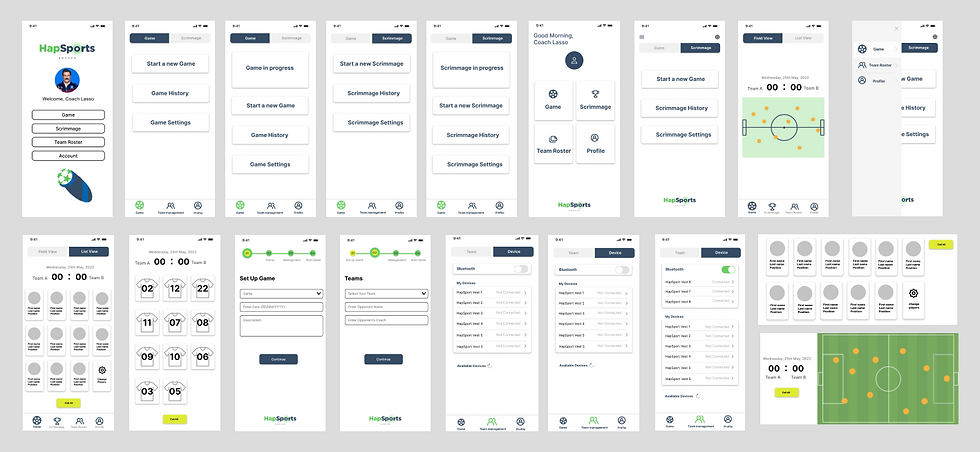
1. Information Architecture

2. App prototype
3. Vest prototype
We designed a removable box with a vibrator, sensor and battery that can be removed to wash. Each box has a code that the team members can read directly to get the vest.

We did research and found that with the development of technology, wearable designs are gradually integrating sensors and so on into one. So we did some technical research and used washable soft batteries, strong conductive fabrics, and impact resistant fabrics to ensure the vest could be washed and ravaged.
Ideation 2

After discussion, we decided to use the second option, combining the sensor and the vibrator into one.

4. Role Play
We did a role play and made paper models to help us better test the design ideas. This turn, we defined more details of the concept.


User Testing
1. Accessing Users
We showed our idea to the coaches and players and they commented on it:
1. The functions about coach are goo!
2. Player to player communication likes “cheating”, which is not fair to others

We seriously considered the “cheating” issue and consulted a professor, and after discussion, we determined the function of the vest to be only on the gap between normal athletes and deaf athletes, so we deleted extra functions, like feeling the teammates’ movement.
In addition, considering technical limitations and considering the portability of the use, we combined the function of the bracelet and vest into one, and changed the action of raising the hand to tapping the shoulder twice.

2. Making Vibration Models
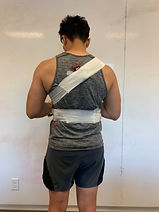
I made a vibrator that can be remotely controlled and put them on the human's body to do our test.
Frist Round


Key Insight
1. The location of the sensors to the right and left of the body did indicate where the player behind was signaling they would run.
2. When running at a faster pace, the sensors needed to have a stronger pulse registry to be felt. The strength of the pulse would need to be further evaluated in future tests.
3. The overall concept proved to work, but in order to undertand the context of an actual game, mulitple players and a coach and referee would need to also be interconnected.
Frist Round
After the last round of testing, we realized we needed more vibrators to test our design ideas, so we made more vibration modules and got more people to join us in our testing. After testing, we asked them what they thought.


Key Insight
1.The vibration could be felt and it was understandable in communicating directional signaling.
2. Delineating between the three zones and which zone is associated to which signal would need further testing.
3. There was an intramural team playing in the park. By observing their game, we were able to note how important verbal communication is when playing.
Branding

The Solution
For Coach
In our research, we found that it is difficult for coaches to gain the attention of team members during matches, especially for deaf athletes. Therefore, coaches often need to shout outside the field to convey information, but the effect is poor (according to interviews with players).
Solution
Therefore, we connect the vibration area at the top of the vest to the mobile app, so that the coach can attract the attention of the team members by clicking on the phone's numbers or player avatars, thereby better conveying information.


UX Flow 1: How to create an account?
-
Log in
-
Sign up
-
Main Page

UX Flow 2: How to start a game?
-
Set up a game
-
Choose/edit a team
-
Connect devices
-
Start a game
UX Flow 3: How to activate the vibrator on players?

-
Player view (check movement of players)
-
List view (check/click number of players)
-
Call all players button
For Players
We found through research that for deaf athletes, due to hearing impairment, they often miss signals from their teammates on the field, which is hard for them to cooperate with their teammates, especially the player behind them, thereby reducing their performance on the field; In addition, due to hearing impairment, teammates' trust in them also decreases.
Solution
A whole soccer team will wear the vest, including deaf players and audible players.
Through prototype and user testing, we set the design goal to 'bridge the gap between deaf athletes and audible athletes'. Use two vibrators below the vest to convey information about the position of teammates on the field.


Trigger action of the sender: Tapping the shoulder
Receiver: Vibration of the vibrator in the same direction as the sender
Scenario


1. A soccer match is being held in Atlanta.
2. The teammate behind the deaf wants the deaf player to pass the ball to him.
Original

3. But the deaf player does not receive signals from his teammates due to hearing impairment.

4. The deaf player lose the ball.

5. The dead player realizes he missed the signal from his teammates.

6. The deaf player wishes he could know the signals.
New


1. A soccer match is being held in Atlanta.
2. The teammate behind the deaf wants the deaf player to pass the ball to him, and he taps his shoulder twice.
3. The deaf player feel the vibration is vibrating on his left back
4. The deaf player passes the ball to this player.

5. This player kick the ball.

6. The ball's got into the net.
For Referee
Through research, signals from referees are also a very important touchpoint in football matches. Although there are currently some ways to prompt referee signals for deaf people, such as giving different color prompts off the field, this can also lead to deaf people needing to pay attention to information off the field at all times, thereby reducing their performance on the field.
Solution
By simultaneously activating three vibrators, attention is drawn to the deaf person's information from the referee.

The sound of whistle

Final Delivery
Final Product


Thanks for watching!!!
.png)
.png)